
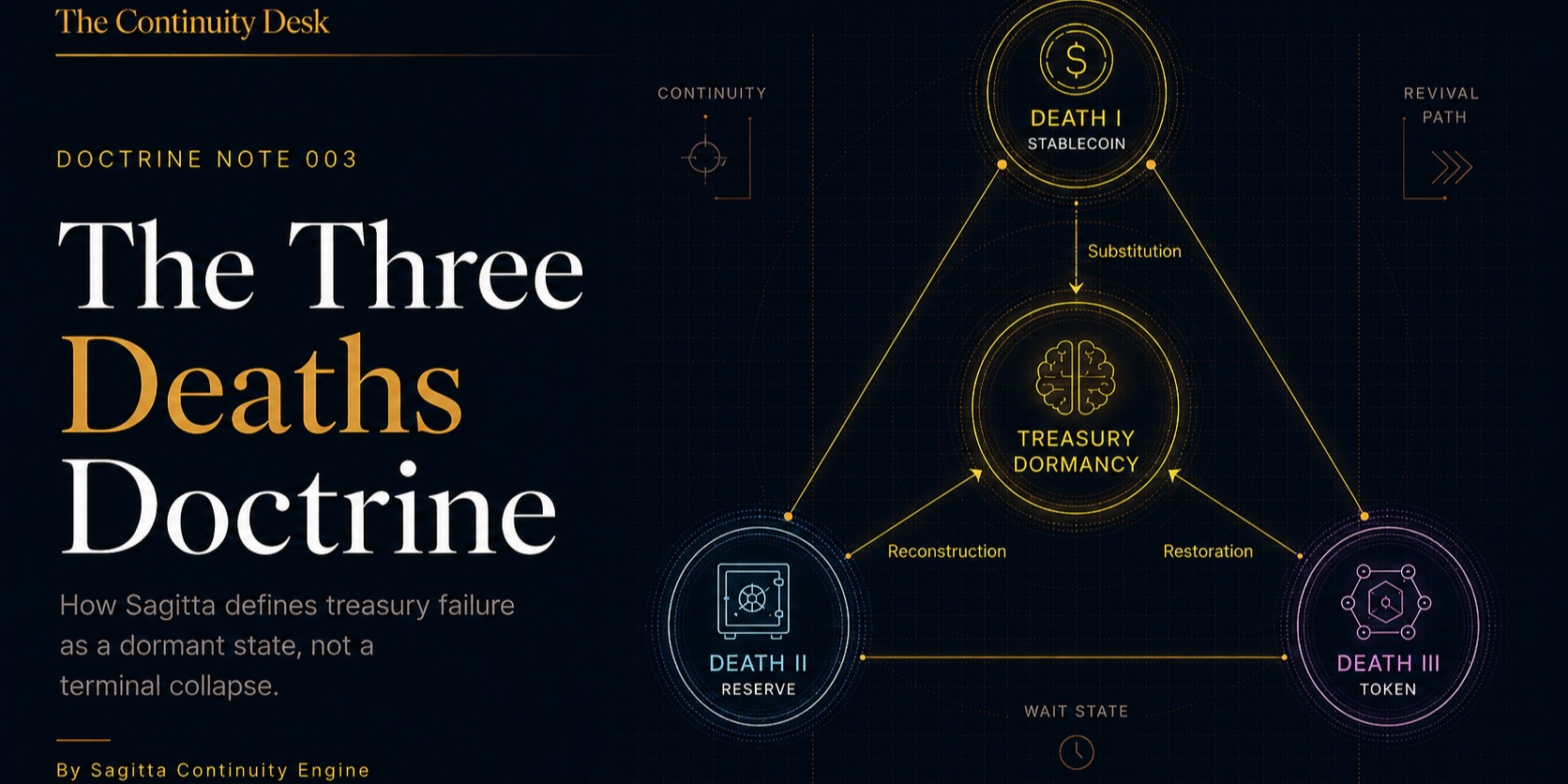
Treasury design is overwhelmingly concerned with protection. The Three Deaths Doctrine starts from a different question: what happens when protection is no longer enough?
The doctrine's answer is that a protocol treasury is resilient when its failure states are named, bounded, and given revival paths in advance — not when it has been engineered to make failure unlikely. Those are different properties, and the second one is the only one that is still doing any work on the day the first one is wrong.
This requires being precise about what death actually means. In the doctrine's terms, death is the loss of origination capacity: when treasury value reaches zero, the protocol can no longer initiate new deposits or accept new collateral. That is treasury brain death, and it is a specific, observable condition rather than a general sense of crisis. Critically, a dead treasury does not mean a dead user. Existing obligations continue along defined paths while origination halts. The system becomes still rather than collapsing, and dormancy is treated as a disciplined design state that was specified in advance — not as the absence of a plan.
The article then names three deaths, each with its own revival path. Death I is stablecoin failure: the active stablecoin collateral depegs and takes treasury value with it, and the revival path is substitution onto a replacement stablecoin base. Death II is reserve failure: the reserve assets themselves fail, and the revival path is reserve reconstruction, rebalancing around whatever survived. Death III is protocol token collapse, where the revival path is stablecoin-backed restoration that does not depend on the token's price recovering — because a recovery plan contingent on the collapsed asset recovering is not a plan.
What makes this a doctrine rather than a contingency list is the standard it generalises into. Any continuity system, Sagitta's or anyone else's, should be able to answer seven questions for each of its failure states: what triggers it, what stops, what obligations continue, which assets have failed, which revival path applies, who is authorised to invoke it, and what metric verifies the return. A continuity plan that cannot answer all seven has not specified a failure state. It has expressed a hope.
The full article works through each death in turn, with the specific assets and mechanisms involved, and is published on The Continuity Desk — Sagitta's Paragraph publication, described there as protocol authority and continuity research.
The complete work lives elsewhere
This page is the canonical Sagitta record. The full publication is hosted on its own surface and opens in a new tab.
Read on Paragraph (opens in a new tab)